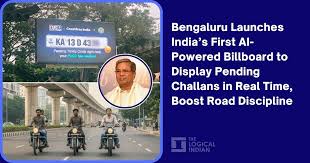

Bengaluru, September 25— Bengaluru has launched a digital billboard with real-time car offenses in a first-of-its-kind project implemented with AI-driven cameras and connected traffic databases. The pilot, which was rolled out at Trinity Circle, is intended to enhance road rule compliance and ensure more accountability among drivers.
How the System Works
The innovative system is driven by AI-linked cameras placed strategically close to the billboard. The cameras shoot vehicle registration numbers as vehicles and two-wheelers move past. The data thus captured is cross-checked immediately with the Vahan database, a central government database that has details of vehicles, including insurance validity, pollution under control (PUC) certificate, and pending traffic fines.
When a vehicle is detected with infractions—like unpaid tickets, lapsed insurance, or lack of PUC—the information is flashed instantly on the LED billboard. Drivers are able to view their vehicle numbers highlighted along with the type of violation. Interestingly, even vehicles with “no violations” are highlighted, providing encouraging positive feedback for compliant drivers.
Objectives of the Initiative
The initiative, according to the Bengaluru Traffic Police, has its central objective in motivating drivers into complying instead of punishing them. By bringing violations into view in real time, the authorities intend to instill social responsibility.
“Most drivers tend to put off renewing insurance or PUC certificates till they are fined. When violations are made public, however, it spurs corrective action at once,” said a senior traffic police officer in charge of the project.
The system aims to cut down on traffic personnel’s reliance on manual checking, thus conserving resources and reducing opportunities for confrontation or bribery.
A First for India
Although comparable real-time violation display systems have been piloted in segments of Europe and East Asia, Bengaluru is the first Indian city to trial such a public-facing accountability model. The initiative is part of the city’s overall push to incorporate smart technology into traffic management.
In the last couple of years, Bengaluru has spent big on AI-powered signal coordination, smart traffic surveillance cameras, and holistic traffic monitoring systems. This new initiative on billboards is adding yet another tier to this tech-based model of governance.
Public Response
The first glimpse of the numbers of vehicles flashing on the billboard has already picked up the attention of people and passersby alike. Responses, however, have been diverse.
Some commuters have welcomed the initiative as a “wake-up call” to inattentive drivers. “It is a great idea. Most people don’t even notice that their insurance or PUC has lapsed. Putting it out in the open makes them move fast,” said Shreya Rao, a daily commuter through Trinity Circle who works in marketing.
Others have, however, expressed concern over privacy and possible embarrassment. The critics have argued that flaunting private car details in public may cause unnecessary shaming or even data misuse.
Traffic authorities have, however, assured the public that the information displayed is minimal—vehicle registration numbers and the type of violation—and does not breach personal data.
Expansion Plans
If implemented successfully, the traffic police intend to roll out the project to other busy junctions in the city, such as Silk Board, Hebbal, and Whitefield. The system in the future can also incorporate QR codes on the billboard so that the violators can scan it and pay their fines directly or renew their documents through official websites.
Authorities also recommended that rewards for good behavior—e.g., showing “clean record” cars or issuing electronic badges—might be incorporated to get more motorists to stay compliant.
Expert Views
Urban mobility experts received the initiative positively but stressed the importance of balanced implementation.
“This is a great application of technology to encourage accountability. But authorities need to make sure that it augments other systemic solutions such as enhancing public transport, making it easy to pay fines, and making compliance processes easy to use,” said Dr. Ashwin Mahesh, an urban planner based in Bengaluru.
He also pointed out that technology cannot be a replacement for long-term infrastructure and policy reforms.
Conclusion
The launch of a real-time violation display billboard is another audacious experiment by Bengaluru in countering its urban traffic woes. By integrating AI technology with public responsibility, the initiative has the potential to revolutionize how drivers interact with road regulations.
As the pilot unfolds, its success will lie in public acceptance, accuracy of data, and the capacity of authorities to grow the initiative responsibly. In the meantime, it is a sobering reminder to the city’s drivers: in Bengaluru’s connected traffic future, there’s nowhere to hide from the rules of the road.