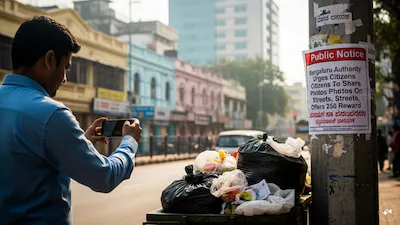

Bengaluru-India’s rapidly growing technology capital-is witnessing one of its most urgent environmental clean-up drives as the Greater Bengaluru Authority launches a major crackdown on three chronic urban challenges: dust pollution, contamination of storm-water drains, and mismanagement of solid waste. This is seen as a major initiative to restore ecological balance to the city amidst rapid urbanization and growth that is placing extreme pressure on public amenities.
Poor air quality, flooding, polluted waterways, and improper waste management systems are some of the issues that have plagued Bengaluru for many years. These have caused not only inconvenience in daily life but serious threats to public health and environmental safety. This new move by GBA is being seen as a way to reverse all these trends through coherent planning, stringent enforcement, and transparent monitoring.
Dust Pollution: A Silent but Serious Urban Hazard
Among the various environmental hazards, dust pollution has become the most common in Bengaluru. Attributed to heavy construction activities, unpaved roads, and careless disposal of debris, the city largely contributes to suspended dust particles. These pollutants inflame respiratory conditions, reduce visibility, and eventually harm the air quality, especially during peak commuting hours.
Against this backdrop, GBA has rolled out a focused action plan, including:
Strict supervision at the construction site
Compulsory covering of building materials
Fines for unregulated dumping of debris
Increased deployment of mechanical sweeping machines
Officials have made it amply clear that builders and contractors must adhere to the environmental norms. Unless compliance is made far stricter, the efforts at dust control cannot succeed. Already, the enforcement teams have started conducting surprise inspections and penalized violators across the city.
Storm-Water Drains: Confronting Pollution and Flooding Risks
Bengaluru’s storm-water drains, popularly known as rajakaluves, continue to be heavily contaminated from sewage discharge, industrial wastes, and illegal dumping. Drains designed to channel rainwater have instead become highly polluted streams, with grossly reduced capacity and wide-scale flooding during the monsoons.
The crackdown by the new GBA aims at reversing this through:
Penalizing industries that discharge untreated effluents
The immediate removal of encroachments obstructing the flow of water.
High-frequency desilting operations
Installation of monitoring systems including sensors and CCTV
Coordinated action between BBMP, BWSSB, and lake authorities
As experts warn, unless the rajakaluves are restored to their natural flow, Bengaluru will continue being prone to floods, water contamination, and infrastructural damage. The initiative is to systematically clean and protect the city’s water network while preventing future encroachments.
Solid-Waste Management: Moving towards Recycling-Based Systems
Bengaluru generates thousands of tonnes of waste every day, and its improper disposal has been a major environmental concern for many years. Landfills around the city have been overwhelmed, and waste segregation practices have remained inconsistent across households and commercial establishments.
However, recent data shows some progress. According to GBA, the landfill-bound waste has reduced from 380 waste trucks per day to 326, indicating better segregation and processing.
Key priorities under the new crackdown include:
Strengthening segregation at source across all wards
Increasing the capacity of local recycling centres
Expanding composting and biomethanation plants
Engaging private companies in waste-processing solutions
Implementing stricter rules on bulk-waste generators
Setting the target at achieving 66–70% recycling is a quantum leap from the present situation. This will be achieved with full public cooperation, more awareness drives, and stricter penalties for non-compliance.
A Long Road Ahead
Officials acknowledge that even with the aggressive crackdown, it will take Bengaluru 15 to 20 years to resolve all the environmental issues. This is just how deep the problems are and require multiagency collaboration over these many years.
They say that Bengaluru needs a metropolitan-level governance structure, scientific models of waste management, and consistent enforcement to avoid repeating past mistakes.
Mixed Response from Locals
Citizens have reacted to this with hope and trepidation, welcoming the long-overdue action, but sceptical due to inconsistent implementation seen in earlier campaigns. Local groups and volunteers began to work with authorities to ensure better waste segregation, report drain blockages, and monitor construction activity.
A step towards a cleaner and more sustainable Bengaluru. The environmental crackdown marks a significant moment in the urban development journey of Bengaluru. By targeting dust, drains, and waste-the three issues that have been playing havoc with the city-the government seeks a clean, safe, and sustainable environment for its citizens. If implemented effectively, this initiative can bring about transformative changes in Bengaluru’s urban infrastructure, public health, and quality of life, so that the city remains not only a technological hub of the world but also an example for sustainable urban living.