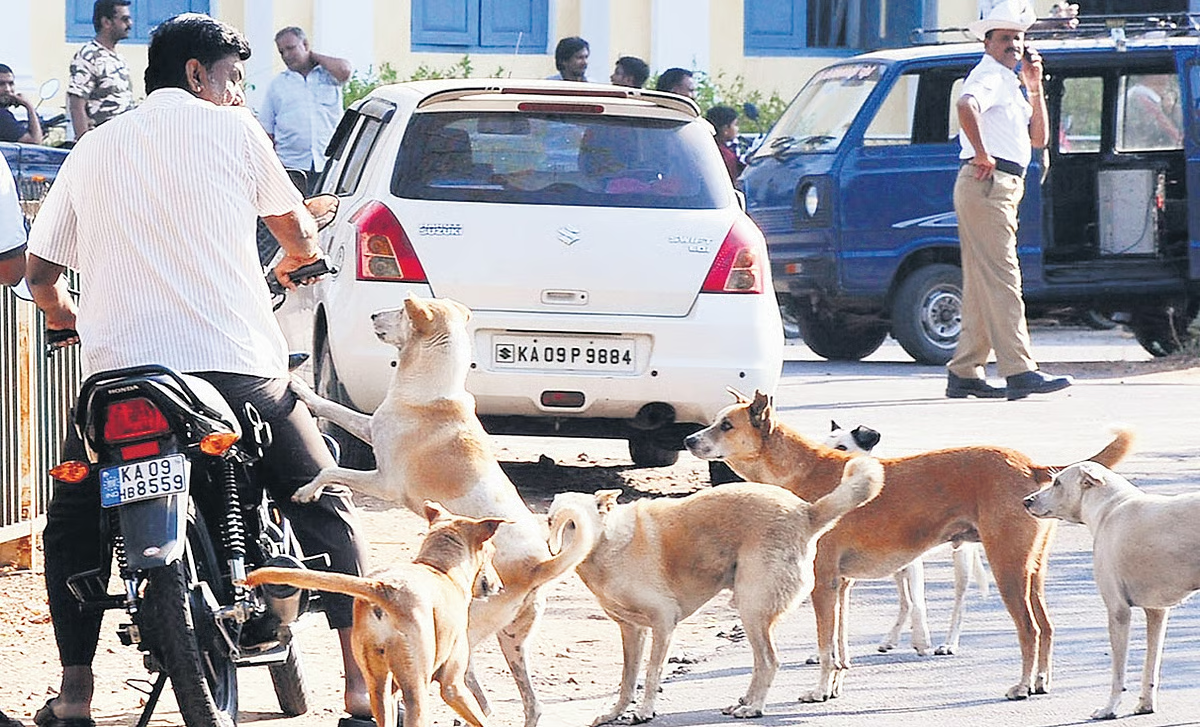

In what could be a major push for urban public-health safety, the Government of Karnataka has issued a fresh compensation order for victims of stray dog bites across all areas administered by the Greater Bengaluru Authority (GBA). The updated notification, dated 18 November 2025, partly amended an earlier notification that was issued in October 2023, with the stated objective of facilitating aid to the victims while improving clinical response and institutional accountability.
Financial Relief for Bite Victims
Under the revised norms, victims who suffer injuries from stray dog attacks—ranging from puncture wounds to multiple bites—will be entitled to ₹5,000 in compensation. The new mechanism provides for ₹3,500 to be given directly to the victim by the Urban Development Department and ₹1,500 for treatment-related support through the state’s health-sector trust for ensuring private hospitals get advance money to treat bite victims without any delay. The new order specifically addresses previous complaints of private hospitals refusing or delaying treatment unless initial payments were made, an issue that had grossly hampered timely care for many low-income residents.
Death Benefits
In tragic cases where the victim succumbs to infection or rabies caused by a stray-dog attack, compensation of ₹5 lakh is assured to the next of kin under this revised framework. This is intended to ensure immediate financial assistance to such families affected by a preventable death, without procedural delays due to bureaucratic processes. The move follows several high-profile cases in Bengaluru involving delays in issuing compensation to the families of victims, including a senior citizen who died in Yelahanka earlier this year.
Committees for Verification and Disbursement
A Verification and Compensation Disbursement Committee shall be established by each municipal corporation under the GBA, which will ensure that the process is uniform and transparent. This committee, comprising officials from municipal bodies, the health department, and legal representatives, shall examine medical reports, confirm the nature of injuries, authenticate the incident, and approve compensation payments. The system is thus intended to rule out anomalies in approving claims for bite injuries, besides a predictable and structured support system for victims.
Why the Revision Was Necessary
Stray dog-bite incidents have turned increasingly sensitive as a civic issue in Bengaluru, triggered by rising stray-dog populations, insufficient sterilisation efforts and recurring cases of aggression in the urban neighbourhoods. The earlier framework by the government was seen as slow, unclear and inadequately funded.
More so, many hospitals had shown uncertainty regarding the assurance of reimbursement for the treatment of the bite victims, therefore showing reluctance in hospital admission. The revised order addresses these loopholes through pre-funding of treatment and defining departmental roles.
The cries for reform had increased after the city had been seeing multiple severe dog-bite incidents in the past few months and also saw widely reported delays in compensation, including months-long waits for families for relief despite clear municipal commitments.
Impact on Residents and Healthcare Providers
The revised norms bring greater security and clarity for Bengaluru’s residents-especially children, senior citizens, and those living in localities with a higher density of stray dogs. With the pre-approved funding for treatment, hospitals cannot deny or delay treatment citing reasons of finances, thereby reducing the medical risk for victims who require immediate anti-rabies vaccination and care for wounds.
The model creates a more predictable reimbursement channel for healthcare providers. The private hospitals will get the treatment-support tranche upfront through government health authorities, allowing for even smoother processes of admission and care.
Challenges Ahead
Despite the positive update, there are still several implementation challenges:
Gaps in awareness may be present among the residents, often belonging to economically weaker neighborhoods.
Hospital Compliance: Strong administrative oversight will be needed to ensure that all private hospitals follow uniform admission protocols.
Efficiency of Verification: Committees should deal with cases in a timely manner so as not to repeat the delays of the past that eroded public confidence.
Long-term Solutions: Compensation does not deal with the aftermath of such attacks but with the root causes like inadequate sterilisation, poor waste management, and insufficient tracking of aggressive animals.
Experts stress that the modified order has to work in tandem with a strong stray-animal control policy, comprising mass vaccinations, increased animal-birth control programs, and awareness drives among the public.
A Step Toward Better Urban Animal-Management Policy While compensation alone cannot solve Bengaluru’s recurring stray-dog conflicts, the revised policy represents a more humane, structured, and victim-centric approach. It aligns municipal responsibility with public expectations and marks a shift toward governance that recognizes both animal welfare and citizen safety as parallel priorities. Indeed, with the Greater Bengaluru Authority setting in motion implementation of the new norms, residents and civic-rights groups would be keenly watching whether timely treatment, rapid compensation and accountable municipal action finally become the standard response to stray dog-bite incidents in the city.