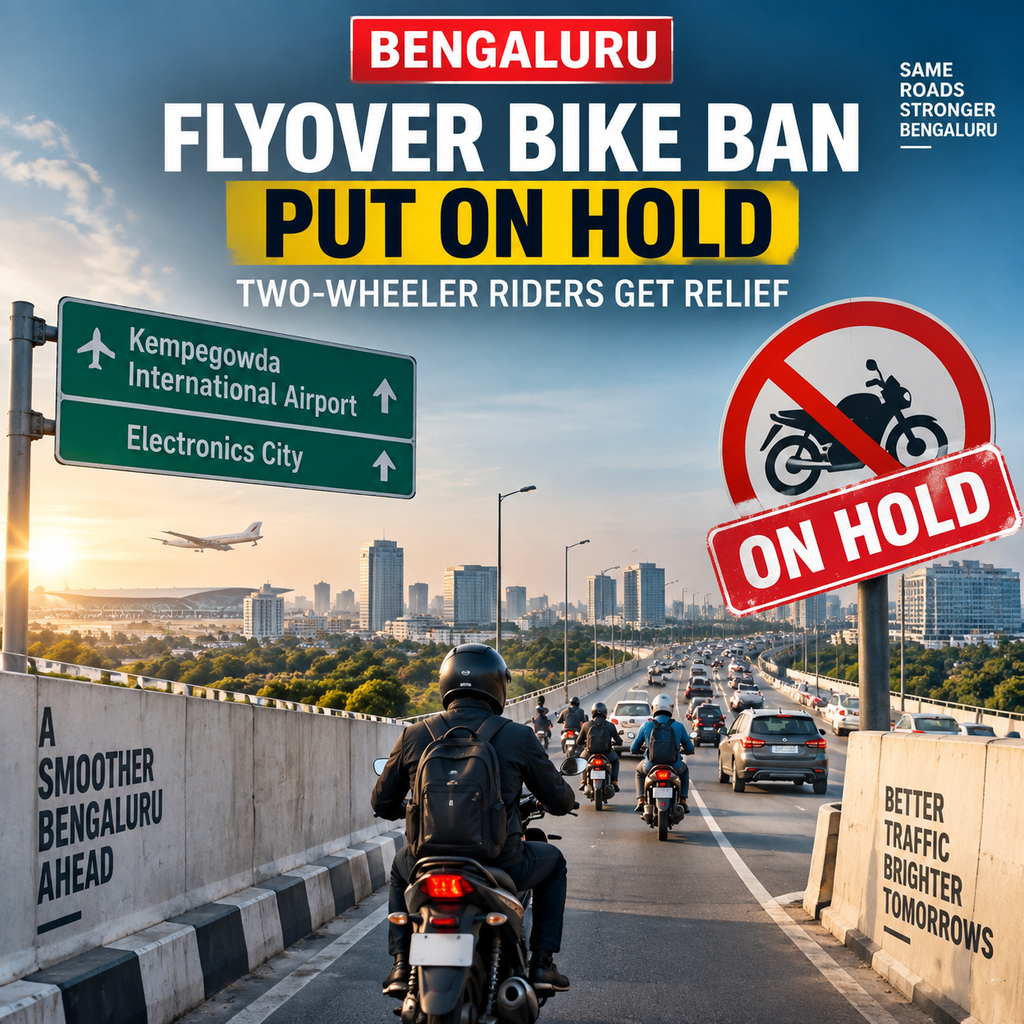
In a major relief for thousands of daily commuters, the Karnataka government has temporarily paused the proposed ban on two-wheelers and autorickshaws on two of Bengaluru’s busiest elevated corridors — the Kempegowda International Airport (KIA) Elevated Road and the Electronics City Elevated Corridor. The decision comes after widespread concerns from commuters and a review of traffic conditions following the initial restrictions.
The restrictions were introduced as part of Bengaluru Traffic Police’s plan to improve road safety and reduce congestion on major flyovers. The move covered multiple elevated routes, including the KIA Road Elevated Corridor, Electronics City Elevated Corridor, BGS Flyover, Peenya Elevated Corridor and the Double Decker Flyover. Authorities aimed to regulate vehicle movement and create smoother traffic flow across the city’s busy routes.
However, the implementation created new challenges, especially on the Airport Road corridor. After two-wheelers, autorickshaws and goods vehicles were diverted to service roads, traffic congestion increased at entry points and surrounding roads. Many commuters reported longer travel times, with several daily riders stating that routes that previously took much less time became significantly slower due to diversions.
Following these observations, authorities decided to adopt a phased approach instead of enforcing an immediate blanket restriction. Home Minister Priyank Kharge said that traffic management decisions should be based on ground-level assessments rather than only official orders. The government will continue monitoring traffic movement, road safety conditions and the impact on nearby roads before introducing further restrictions.
Under the revised plan, two-wheelers and autorickshaws will continue to be allowed on the KIA Elevated Corridor for now. Restrictions on goods vehicles during peak hours will continue. A similar approach will be followed for the Electronics City Elevated Corridor, where authorities will first assess traffic patterns before implementing additional restrictions.
The decision has brought relief to Bengaluru’s massive two-wheeler community. With millions of motorcycles and scooters operating across the city, many commuters depend on elevated corridors to save time while travelling between residential areas, business hubs and IT zones. The Electronics City route is particularly important for thousands of employees travelling daily to Bengaluru’s technology hub.
Traffic officials have also advised riders using the permitted flyover stretches to follow lane discipline, avoid unsafe overtaking and maintain safe speeds. Authorities are expected to continue studying traffic patterns before deciding whether permanent restrictions are required or if alternative solutions can improve road safety without increasing congestion elsewhere.
The latest move highlights Bengaluru’s ongoing challenge of balancing traffic management, road safety and commuter convenience. As the city continues to expand, authorities are under pressure to create smarter transport solutions that reduce congestion while keeping daily travel practical for millions of residents.